Curious if the Martingale strategy really works in blackjack? Discover how real players use it in casinos and live-dealer games, how it feels, and what makes it

Can You Use the Martingale Strategy in Blackjack? Absolutely — and Here’s How It Really Works.
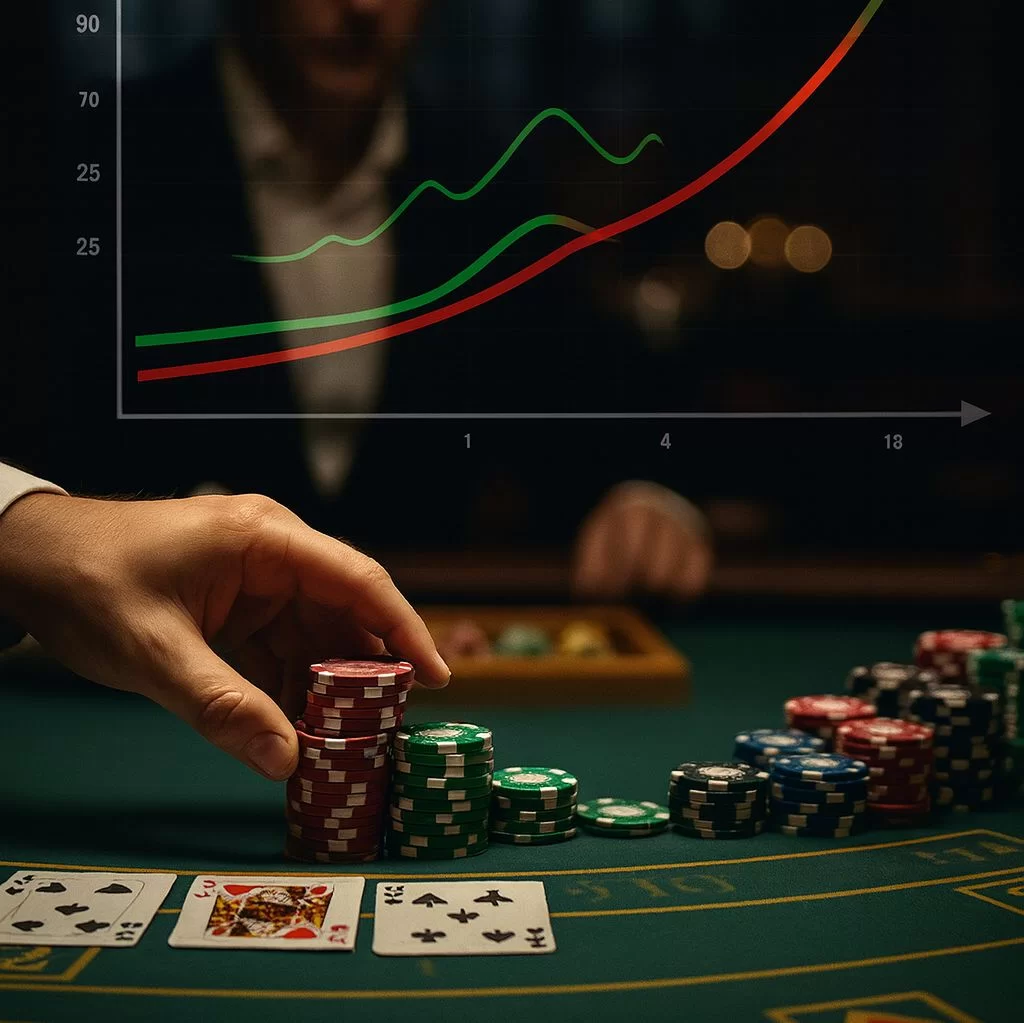 If you’ve ever sat at a blackjack table and wished there were a simple, repeatable way to decide your bet size, you’ve probably come across the Martingale strategy. It’s one of the oldest betting systems in the world — the classic “double after every loss” method that promises to make your next win cover all previous defeats.
It became famous through roulette, where players double their stakes on red or black. But blackjack fans have long adopted it too, adding their own twists, emotions, and little rules. The result is something surprisingly human — part logic, part ritual, and part adrenaline.
Let’s walk through how the Martingale system really works when applied to blackjack, how players actually use it in both land-based and online live-dealer games, and why it keeps its mysterious charm even in the age of analytics.
What the Martingale System Actually Is
The idea couldn’t be simpler. You start with a base bet — say, $10. If you win the hand, great — you stay at $10. But if you lose, you double your next bet to $20. Lose again? Go to $40. Then $80. Then $160.
The theory says: when you finally win, that single victory covers every previous loss and gives you a profit equal to your original $10. After that, you reset to the base bet and begin again.
It’s a progression — a betting rhythm built on the expectation that eventually, you’ll win. It doesn’t matter whether that happens on the second or the eighth hand — the system is meant to “catch” you on the way down and bring you back to even.
In roulette, this logic feels neat and binary: red or black, win or lose. In blackjack, though, there’s more texture. You can draw, double, split, or surrender. Sometimes you push with the dealer — which means no win, no loss — and you must decide whether to treat that as a reset or not.
That’s where blackjack players personalize the system. They adapt it to the game’s rhythm and their own comfort zone.
Why Blackjack Players Like It
Martingale appeals to people for psychological reasons as much as mathematical ones. It feels clean. It removes indecision. You don’t need to think about lucky streaks, card counts, or the dealer’s “tells.” Your plan is already set before the cards hit the felt.
There’s also a rhythm to it — a heartbeat. Win small, lose small, double, recover, reset. It creates its own flow inside the game. Players who enjoy that sense of control, or who like keeping emotion in check, often say it helps them stay focused.
And because blackjack hands move fast, there’s constant feedback — you can experience multiple Martingale sequences within one session. For people who enjoy structure, it’s almost meditative: mechanical, predictable, and oddly satisfying.
How People Actually Apply Martingale in Blackjack
1. The “Classic” Version
This is the purest form — straight doubling after every loss, resetting after a win.
- Start with $10. Lose → bet $20.
- Lose again → $40.
- Lose again → $80.
- Win → back to $10.
Many casual players keep it simple, tracking their progress mentally or with chips stacked in sequence. It doesn’t require math, just discipline to follow the pattern.
2. The “Soft” Martingale
Some prefer a gentler curve: instead of doubling, they increase by 50% or 75% after each loss. It slows the climb, letting the bankroll breathe longer. It also reduces emotional tension — no sudden $160 hands after a few bad runs.
3. The “One-Win” Reset
Another common version is stopping after the first win of the sequence, taking that small profit as a mini-victory and starting over. Players using this style focus on many short “loops” instead of long streaks. It gives them more frequent sense of closure — psychologically rewarding even if mathematically the same.
What Makes Blackjack Different from Roulette for Martingale
Martingale behaves differently here because blackjack is not a pure 50/50 game.
- Pushes happen — about 8–9% of all hands end in a tie. You neither win nor lose, but it interrupts the rhythm.
- Double downs and splits add complexity. A single hand can suddenly double in cost mid-sequence. Some players avoid doubling during a Martingale run to keep things under control.
- House edge is smaller (around 0.5–1%), but it still exists. The system doesn’t change that edge — it just structures your exposure to it.
And then there’s human behavior. In real blackjack, players often mix in intuition: “I’ll skip the double this time,” or “I’ll raise one more level; I’m due for a win.” That’s what makes Martingale fascinating — it becomes less about perfect math and more about personal rhythm and emotion management.
How It Feels in Real and Online Casinos
In a land-based casino, the physical aspect changes everything. You’re touching chips, reading the dealer’s eyes, hearing the shuffle. The pace is slower, which gives you time to think — or to overthink. After three losses in a row, your next bet suddenly looks huge on the felt, and the adrenaline spikes.
At a live-dealer online table, it’s a different world. The game is faster, more detached. You don’t have to worry about other players’ opinions, and the interface shows your running balance automatically. You can apply the Martingale rhythm more precisely, even test different versions without social pressure.
Some players like practising on RNG blackjack simulators — risk-free digital tables where they can watch how often a losing streak grows before it resets. It’s like training muscle memory for emotional control.
Then there’s Speed Blackjack — a live format that forces decisions fast. Some fans say it’s the ultimate Martingale test: can you keep your cool and stay in rhythm when the game moves twice as fast?
Table Limits, Bankrolls, and the “Human Ceiling”
In theory, you could double forever. In reality, every casino — online or live — has table limits. That’s the built-in safety valve. You might start at $10, but after eight losses you’d be betting $1,280. If the table max is $1,000, your sequence ends before recovery.
Bankroll also matters. Most casual players set a personal ceiling — maybe six or seven steps max. When they reach it, they either reset to the base bet or take a break.
Some even invent “hybrid” progressions: double for the first few losses, then switch to a flat bet until a win appears. Others link their progression to side bets, treating them as bonus spice — small extra bets like “Perfect Pairs” that give a thrill without breaking the main system.
Why It’s Still Popular
For all its simplicity, Martingale endures because it scratches a deep itch: the desire for a system. Something that feels like a plan in a game that’s half chaos.
Players like that it gives structure to the ups and downs. It’s not about winning the world — it’s about staying in the game, feeling in control, and adding rhythm to randomness.
The system also invites experimentation. Some players blend Martingale with other betting philosophies: stop-loss limits, Fibonacci progressions, or even mild card counting to time their entries. Others use it just for the social fun — comparing who survived the longest streaks before hitting the table limit.
Trying It for Yourself
If you’re curious about testing Martingale in blackjack, start small and do it on trusted platforms. Arab Casinos has gathered a selection of verified, secure gaming sites designed for Arabic-speaking players — including blackjack tables with real dealers, multi-hand modes, and demo options for practice.
You can explore classic and live versions, track your betting rhythm, and see how your personal version of Martingale plays out in different environments.
Many players like to warm up in demo mode first — feel the doubling pattern, learn when emotion starts to rise — and only then move to live tables. The moment when a win “resets” your sequence feels genuinely satisfying, especially in a live-dealer stream where chips and voices make it feel authentic.
The Takeaway
The Martingale strategy in blackjack isn’t a relic from gambling history — it’s alive and well, adapted by players who enjoy the balance between order and chance. It gives structure to the game’s chaos, adds an emotional rhythm to betting, and turns each session into a personal challenge.
You’ll see it in small local casinos, you’ll find it at online tables, and you’ll recognize that tiny grin on a player’s face when their doubling finally pays off. Whether you play it for curiosity, discipline, or just the fun of it, Martingale remains one of the most human ways to experience the dance of blackjack — steady, simple, and a little bit daring.
If you want to explore it yourself, Arab Casinos is the place to start — with trusted platforms, fair tables, and all the blackjack variations where that famous rhythm can come to life.
Best Casinos