Learn how to choose smarter blackjack, roulette and baccarat tables by understanding RTP and house edge — without losing the thrill of live play.

When you enter a live casino table, you’re not just looking at numbers.
You’re reading the atmosphere. The pace. The dealer’s rhythm. The way other players are betting. There’s anticipation in the air — especially in live roulette and baccarat. That moment before the reveal is part of the experience.
But here’s the strategic layer most players skip:
Before you feel the adrenaline, you choose the structure.
And structure defines cost.
RTP and house edge are not abstract math terms. They’re filters. They determine whether you’re paying a premium for the same entertainment — or getting better value for the same thrill.
Quick Reset: What RTP and House Edge Actually Mean
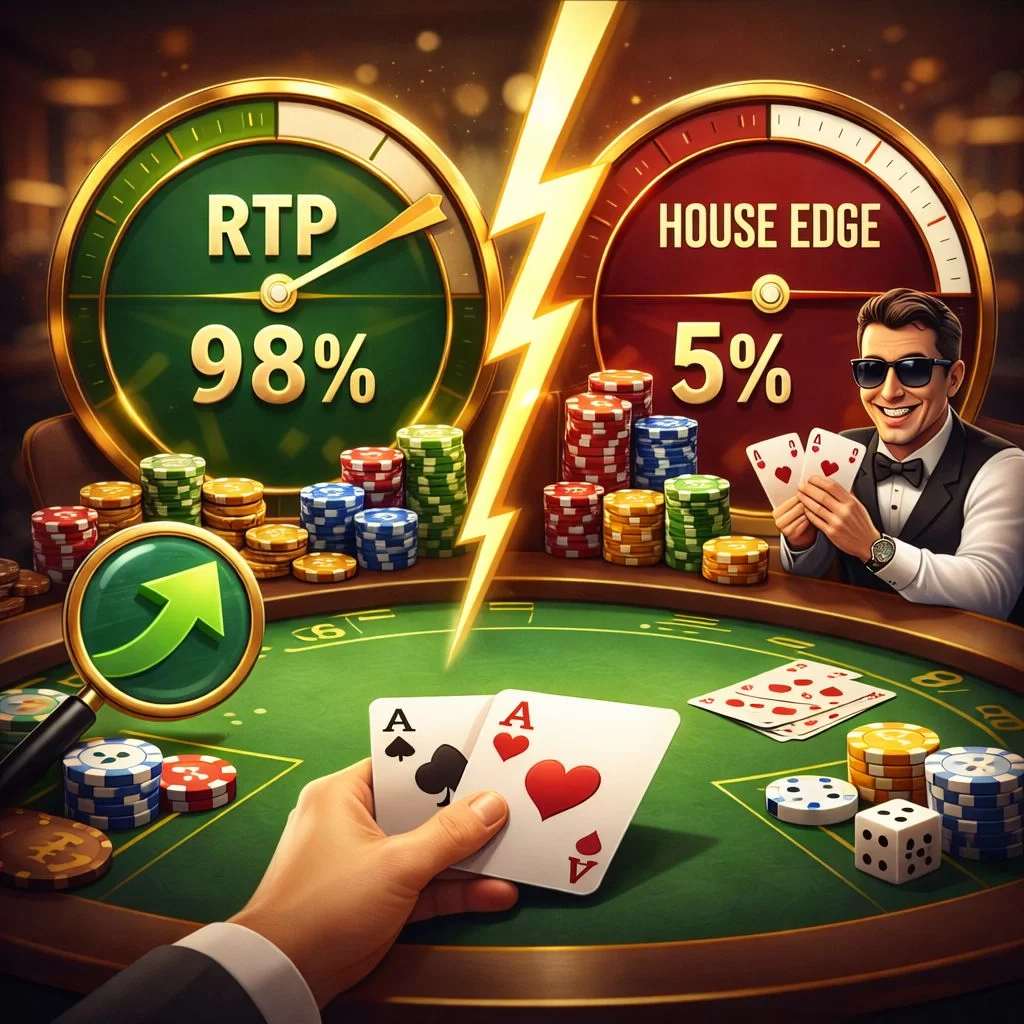
RTP (Return to Player) is the percentage a game returns over time. House edge is what the casino keeps.
If RTP is 99.5%, house edge is 0.5%. If RTP is 97.3%, house edge is 2.7%.
That difference may look small. It’s not.
If you wager $10,000 over multiple sessions:
- At 0.5% edge → expected loss ≈ $50
- At 2.7% edge → ≈ $270
- At 5.26% edge → ≈ $526
Same game category. Very different structural cost.
Now let’s talk strategy — game by game.
Entering a Roulette Table: What Do You Check First?
Roulette feels simple. But the decision starts before the wheel spins.
When you approach a roulette table, look at:
- Wheel type (European or American)
- Presence of La Partage or En Prison rules
- Table minimums relative to your bankroll
The wheel type is critical.
European roulette has 37 numbers (0–36). American roulette adds a 00.
That single extra pocket almost doubles house edge.
European roulette: about 2.7%. American roulette: about 5.26%.
No betting pattern can offset that difference. Not Martingale. Not Fibonacci. Not “hot numbers.”
If the table offers La Partage or En Prison on even-money bets, effective edge drops to about 1.35%. That’s one of the strongest structural positions in mainstream roulette.
Strategic takeaway: If two roulette tables look identical but one is American and one is European, the European table is mathematically superior. Always.
Now the experience side.
Roulette is about rhythm. If the table is too fast and you feel rushed, decision quality drops. If it’s too slow, impatience leads to forced bets.
Choose a pace that matches your focus. Strategy isn’t only about math — it’s about clarity under pressure.
Sitting at a Blackjack Table: The Silent Rule Check
Blackjack is where rule details matter most.
Before your first hand, check:
- Blackjack payout: 3:2 or 6:5?
- Dealer stands or hits on soft 17?
- Number of decks?
- Double after split allowed?
If you see 6:5 payout, leave. That single change can push house edge close to 2%, compared to roughly 0.5% on a strong 3:2 table.
That’s nearly four times worse — without changing the feel of the game.
Blackjack is unique because your decisions matter. With proper basic strategy and good rules, edge can drop below 1%.
That makes blackjack one of the most structurally efficient live games — if chosen correctly.
But here’s the emotional layer.
Live blackjack is interactive. You see cards unfold. You react. You adjust. You experience momentum shifts.
Understanding house edge doesn’t kill that energy. It strengthens it. Because every decision you make fits into a system, not chaos.
When you double down or split, you’re not guessing. You’re executing structure.
That’s a different kind of confidence.
Approaching a Baccarat Table: Simplicity With Discipline
Baccarat looks elegant. Clean layout. Fast dealing. Smooth flow.
The strategic check is shorter, but still important.
Before betting, look at:
- Commission on Banker bet (usually 5%)
- Available side bets
- Speed of dealing
Core house edges:
- Banker bet ≈ 1.06%
- Player bet ≈ 1.24%
- Tie bet 14%+
Tie looks attractive because of 8:1 payout. But the edge is significantly higher.
If your goal is structural efficiency, Banker bet is statistically strongest — even with commission.
Pattern tracking is part of baccarat culture. Many players follow streaks or “roads.” That’s part of the psychological dimension of the game. But mathematically, streaks don’t change underlying probabilities.
Strategy here is about discipline. Not chasing volatility.
Enjoy the flow. But understand the cost of each bet type.
Side Bets: Where Excitement Gets Expensive
In blackjack and baccarat, side bets add drama.
Perfect Pairs. 21+3. Dragon 7. Super 6.
They are exciting because payouts are larger and variance is higher.
They are also expensive — often carrying 7% to 25% house edge depending on the version.
That doesn’t mean “never play them.” It means:
- Don’t build your session around them.
- Treat them as optional spice, not foundation.
Core bet first. Entertainment layer second.
Live Experience: Why Structure Extends Enjoyment
Some players think focusing on house edge makes gambling mechanical.
It’s the opposite.
Lower house edge means slower theoretical loss. Slower loss means longer sessions. Longer sessions mean more rounds, more dealer interaction, more emotional arcs.
In live casino, enjoyment is multi-layered:
- The anticipation before cards turn.
- The social exchange with the dealer.
- The tension during a long roulette spin.
- The strategic satisfaction of executing correct decisions.
Math doesn’t replace these elements. It sustains them.
You’re not reducing the game to numbers. You’re protecting your session.
A Practical Strategic Routine
Before placing your first bet, pause for 30 seconds.
- Confirm roulette wheel type.
- Check blackjack payout ratio.
- Look at baccarat commission and avoid high-edge bets.
- Match table minimums to your bankroll size.
This small habit shifts you from reactive player to structured player.
Final Perspective
There is no betting system that removes house edge.
But there is table selection.
You can’t control variance. You can’t control short-term outcomes. You can control structure.
In the end, smart casino strategy isn’t about chasing miracles.
It’s about entering the right table — with eyes open — and letting both enjoyment and discipline work together.
That balance is where real strategic play begins.
Best Casinos