Can you beat roulette by watching the wheel? Explore the truth behind Visual Ballistics in online and live roulette — and a legendary tilted-wheel tale.

There’s a method out there—quietly passed around in gambling forums and old-school player circles—that promises an edge in the game of roulette. It doesn’t involve math, betting systems, or special software. Just eyes. And timing. It’s called Visual Ballistics.
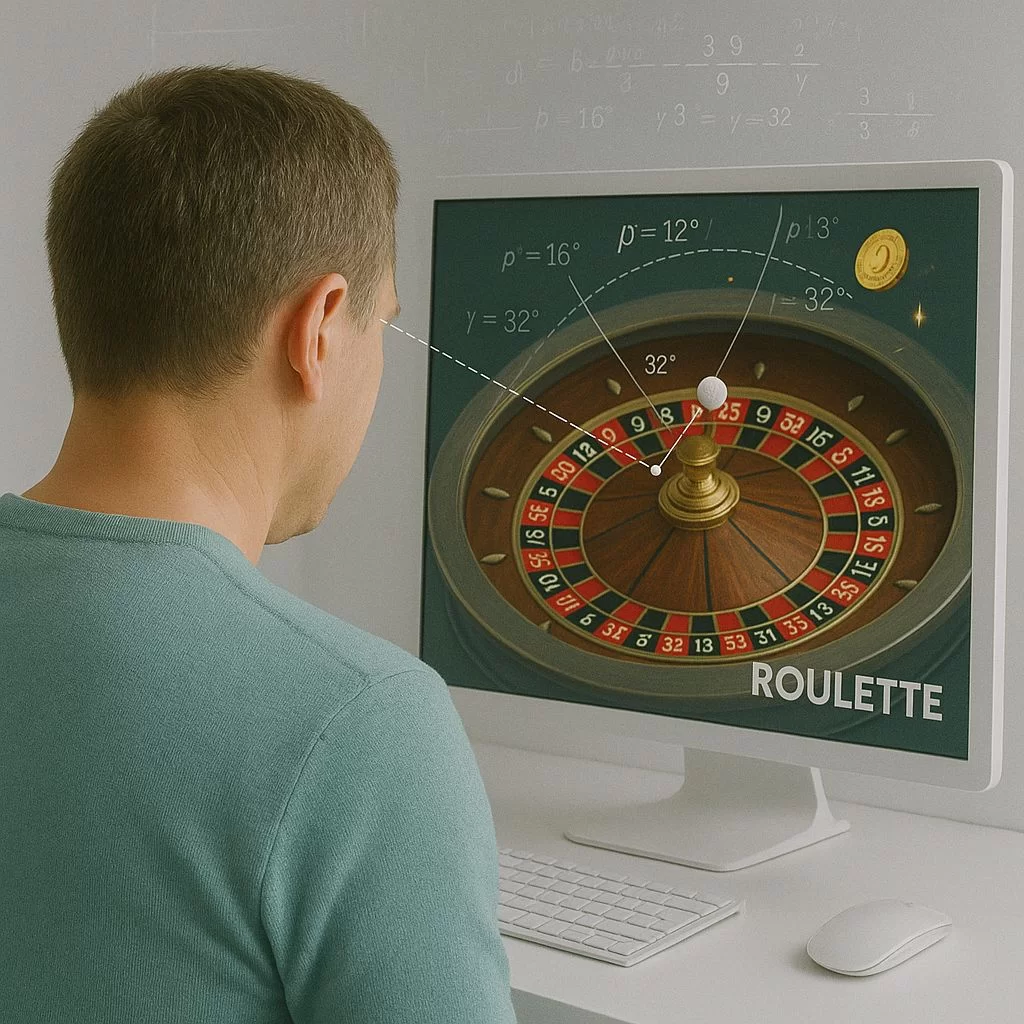
This technique is all about watching the physical spin of the roulette wheel and ball—and using what you observe to predict where the ball will land. Sounds elegant, right? Maybe even clever. But the real question is: does it actually work? And if it does, then where and when?
Let’s break it down: where this strategy comes from, why it fails in many modern settings, and whether there’s still a place for it in today’s roulette landscape. Along the way, we’ll revisit one colorful tale about a fireplace, a tilted wheel, and a player who got just a little too good.
What Is Visual Ballistics?
Visual Ballistics is a prediction method based on observing the real-time behavior of a roulette ball and wheel. It has nothing to do with betting progressions or statistical tracking. It’s purely physical. The player watches the spin—looking for visual cues such as the ball’s speed, the rate of deceleration, how it bounces off the deflectors (called “diamonds”), and how the wheel itself behaves.
The idea is that if you can consistently identify the moment when the ball passes a reference point—say, a certain diamond—and estimate how many pockets it will travel from that point before dropping, you can predict the likely sector where it will land. If done well, this technique could reduce the number of “possible” numbers from 37 (or 38) down to 8–12. That’s a huge statistical advantage—at least in theory.
The key is pattern recognition. But it’s not easy. You need sharp focus, fast reflexes, and most of all, a consistent wheel to work with.
Where It Comes From: The Golden Age of Physical Roulette
This technique has its roots in old-school, physical roulette. Back in the day, many casinos had slightly imperfect wheels. Tiny manufacturing flaws or years of wear and tear meant that some wheels had biases—small tilts or friction points that made certain numbers more likely to hit than others.
Professional players learned to spot these flaws and either manually tracked results over hundreds of spins or combined that with visual observation. Some used concealed tech , but the purest form of the craft involved nothing but sharp eyesight and hours of practice.
In that environment—real ball, real wheel, slightly imperfect hardware—Visual Ballistics could work. And in some rare cases, it worked very well.
Why It Doesn’t Work in RNG Roulette
The moment roulette became digital, the game changed forever. If you’re playing on a site that uses RNG (Random Number Generator) software, Visual Ballistics is completely useless. There’s no real wheel. No real ball. Nothing to observe. The game is just an interface that displays animations. The actual outcome is generated instantly, invisibly, by code.
It doesn’t matter how good your reflexes are. There’s no moment of deceleration to measure. The wheel is an illusion.
Trying to apply physical prediction to RNG-based roulette is like trying to guess which cloud will rain by staring at a weather app. You’re watching a simulation, not a system you can influence or interpret.
So, for all practical purposes, Visual Ballistics in RNG roulette is pure fiction.
What About Live Dealer Roulette?
Now here’s where things get interesting. Live dealer roulette streams a real wheel, real ball, and real dealer to your device. That means the physical dynamics are back in play. In theory, that reopens the door for Visual Ballistics. You can watch the spin, estimate the velocity, and try to predict the result just like you could in a land-based casino.
But theory and practice are two very different things.
There are a few big limitations that make visual prediction in live roulette extremely difficult:
- Betting closes early. Many live casino tables stop accepting bets soon after the wheel is spun. That leaves you with very little time to observe and react.
- Camera angles aren’t ideal. Most live streams don’t show the ball and wheel at the right angle or resolution to allow precise analysis.
- Wheels are well-maintained. Online casinos rotate equipment regularly, check for bias, and train their dealers to vary spins to prevent predictability.
- Human skill gap. Even if you had a perfect view and ideal timing, it would take months of practice to become even mildly effective at this.
That said, there are some advanced players who claim they can apply Visual Ballistics in live games—especially on certain platforms where wheel conditions are consistent and betting windows are generous. But for most players, it's a high-effort, low-reward endeavor.
The Tilted Wheel by the Fireplace
And now, the fun part. A story that’s been passed around the gambling world, half in disbelief, half in admiration.
It’s said that years ago, in a boutique casino somewhere in central Europe, there was a roulette wheel stationed in a cozy corner of the gaming floor. It was a beautifully maintained room, with velvet drapes, wood paneling, and a large, open fireplace—not for show, but for actual warmth during winter.
As the story goes, the wheel sat a little too close to that fireplace. The radiant heat from the fire, over time, subtly warped the structure. Not enough for the eye to notice. But enough to cause the wheel to lean ever so slightly in one direction.
Enter our main character: a quiet, observant man with no flashy moves or wild bets. He showed up every evening, ordered the same drink, and took a seat near the fireplace table. And he watched.
He didn’t play right away. For the first few nights, he took notes. Only after several sessions did he begin to bet—and when he did, it was on a very narrow set of numbers. And he won. Not every time, but often enough to make the pit boss nervous.
Eventually, management reviewed surveillance footage. No cheating devices. No collusion. Just one man with a notebook, an excellent sense of timing, and, apparently, a grasp of physics. They brought in a technician to examine the wheel, and sure enough—it had developed a slight tilt, biased toward a particular sector.
The wheel was replaced the next day. The man never returned.
So, Is It Worth Trying?
In the end, Visual Ballistics is a dying art.
In RNG games, it’s totally ineffective. There’s no physicality to exploit, and the results are generated faster than any observation can occur.
In live roulette, it’s not completely dead—but it's very difficult to apply with any real consistency. Conditions have to be just right: predictable dealers, visible wheels, generous timing, and no random equipment changes.
Does that mean no one should ever try it? Not necessarily. For the curious, the mathematically inclined, or the obsessively observant, it can still be a fascinating exploration of what happens when physics meets chance. And if you ever find yourself in a real casino, staring at a wheel near a fireplace—well, maybe keep an eye on it.
But remember: the moment you win too often, someone’s going to notice.
Best Casinos