Deposits and withdrawals — what casino transactions really show on your bank statement: the descriptor, the MCC, KYC on cash-outs, and how card, crypto differ.

Money goes into your casino account, and later it comes back out. Both legs touch your bank — and most players quietly wonder what each one leaves behind. Relax: it's almost never "CASINO" in bold capitals. But deposits and withdrawals show up differently, and the way back out is where privacy actually gets tested. Here's the full round trip, and who sees what.
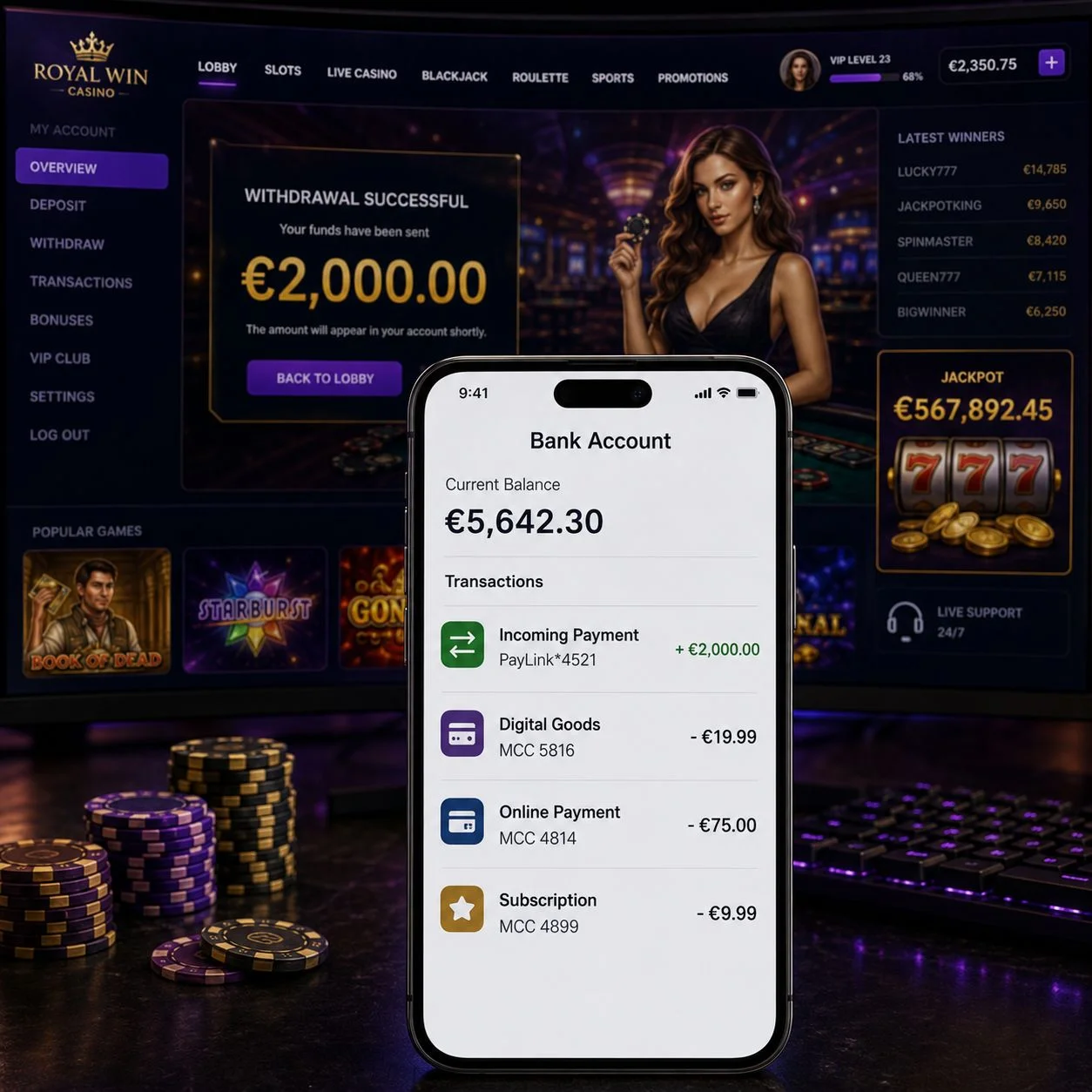
The Two Things on Every Transaction
Every card payment carries two separate pieces of information, and people mix them up constantly.
The first is the descriptor — the text you read on your statement. It's often neutral: the name of a payment processor, a generic trading name, sometimes a string that means nothing at a glance. Casinos and their payment providers know the topic is sensitive, so a clean descriptor is common. You'll rarely see a flashy casino brand spelled out in full.
The second is the MCC — the merchant category code. It's a four-digit tag the bank sees in the transaction data, even though you usually don't. For gambling, Visa's rule is MCC 7995, "betting and casino gambling." So, your statement line can look completely generic while the bank still reads the category underneath.
That's the honest picture: the words are usually soft, but the category isn't automatically hidden from your bank.
But Not Every Casino Uses 7995
Here's the twist most guides skip: the MCC isn't always 7995. Some operators — and the processors behind them — route transactions under different codes entirely. Digital-goods and games categories like MCC 5816 (Digital Goods – Games) or MCC 7994 (Video Game Arcades) show up in the wild, and to the bank the payment then looks like an ordinary digital purchase rather than gambling.
Card networks intend 7995 for real-money gambling, so this alternative coding sits in a grey area and isn't something a casino advertises. But it's real, and it's a big reason two players at two different casinos can see nothing alike on their statements.
Deposits: The Quiet Half
On the way in, a card deposit is an outgoing payment — modest, routine, easy for a bank to wave through. The descriptor is usually neutral and the MCC decides how your bank reads the category. This is the calm side of the cycle: soft text, often a generic classification, rarely a second glance. Nine times out of ten, funding your account is the part nobody notices.
Withdrawals: Where Privacy Is Actually Tested
A withdrawal is money landing in your account, and incoming transfers draw more attention than routine card spends — they're larger, irregular, and clearly "money in" from a merchant. A neutral descriptor helps less here. Two things kick in that deposits never trigger:
- KYC and source of funds. The casino verifies your identity before releasing a payout — ID, proof of address, sometimes proof of your deposit method. Separately, your own bank may ask about a large or unusual incoming sum. With your paperwork in order it's routine; the point is to expect it, not be caught out by it.
- Closed-loop payouts. Most casinos return funds to the exact method you deposited with — card back to that card, wallet back to that wallet. It's an anti-money-laundering standard, and it also shapes your statement: the money comes back along the same trail it left by, not some random new route.
Withdrawals also move slower — pending review windows, and large sums often paid in instalments against daily or weekly limits. That delay is processing and checks, not your money being at risk.
Card, E-Wallet, Crypto — Both Directions
How much shows depends on the rail, in and out.
Card — a deposit shows a neutral descriptor plus the MCC; a payout back to the card appears as a credit or refund from the same processor. Traceable both ways, but usually under the same soft name.
E-wallet (Skrill, Neteller and similar) — deposit and payout both touch only the wallet on your statement. The casino sits one step behind it in both directions. Clean separation each way.
Crypto — a deposit shows as a purchase at an exchange; a crypto payout never touches your bank at all — it lands in your wallet, and only if you later cash out to your bank does anything appear, as an exchange transaction. The most private route in and out, which is why discretion-minded players lean on it. For the full picture, see Arab Casino Payment Methods: Crypto Wins in 2026.
Why Your Bank Might Flag It
Two different frictions, one per direction. On deposits, an MCC 7995 payment can be declined outright by banks that block gambling by policy — soft text won't rescue a blocked category, which is exactly why casinos lean on alternative MCCs and on e-wallet and crypto rails. On withdrawals, it's rarely a block and more often a question: a large incoming sum can trigger a source-of-funds query from your own bank. Neither is a real problem when your documents are ready — both are simply easier to handle when you see them coming.
Reading Your Own Statement
Not sure a line is you? Match the amount and date to your deposit or payout first. An outgoing charge under an unfamiliar name is usually the payment processor, not the casino — search the exact string and it'll trace back to a gaming payment provider. An incoming credit from an unfamiliar merchant is typically your withdrawal arriving under that processor's name. Repeated, identical small amounts are your own deposits, not an error. A genuine mistake is worth a dispute; a deposit you made or a payout you requested is not.
So What is on a Player's Bank Statement?
Deposits are the quiet half — soft text, easy to miss. Withdrawals are where privacy is actually tested: bigger, incoming, and checked, with KYC on the casino's side and possible questions on your bank's. No neon "CASINO" either way. Know your route in and out, keep your verification ready, and there are no surprises on statement day.
Best Casinos