Where six-figure baccarat hands actually happen online — dedicated tables, Asian studios, squeeze format, and what to negotiate with the operator before sitting

High-stakes baccarat exists online. The catch is that it's almost never in the live lobby you see when you log in. Public tables top out at $5,000 to $10,000 a hand across most operators. The rooms where six-figure hands actually happen aren't listed anywhere — they're configured on request, served from specific studios, and reached through a single point of contact at the operator. This piece walks through how that architecture works, who plays at those stakes, and what the game actually delivers at the top end.
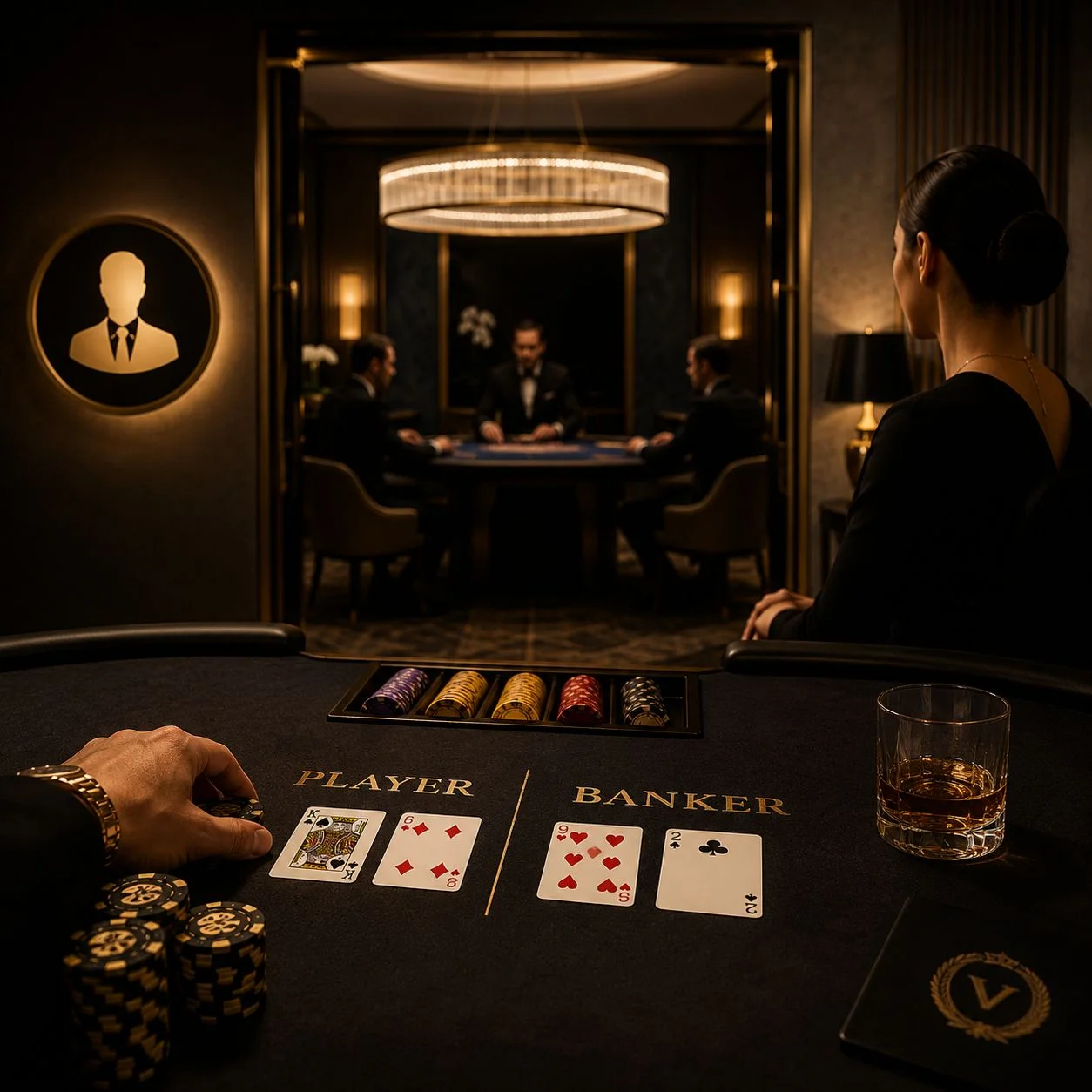
Why Baccarat Became the High-Stakes Game
Baccarat's global high-roller status was built in Macau. The city's casino floors were designed around it — private rooms, dedicated dealers, ritualized handling of the cards — and the rest of Asia followed. By the time online live casino matured in the 2010s, baccarat had been the dominant high-stakes table game globally for over a decade.
The reasons are in the game itself. Banker bet carries a house edge of 1.06%, one of the lowest in any casino game. Player bet is 1.24%. Hands resolve in 30 to 40 seconds. There's effectively no strategy — the cards are drawn according to fixed rules, the player makes one decision per hand. For someone betting six figures, this profile matters: low edge, fast turnover, no cognitive load. The game rewards bankroll discipline, not skill, which is exactly what players at this level want.
Among Gulf high rollers specifically, baccarat is a niche taste rather than a default. Most players in the region gravitate toward live blackjack, live roulette, and high-volatility slots. The high stakes online baccarat crowd within the GCC tends to be smaller but distinct — often players who developed the taste through travel to Asia, with online casinos in Dubai and the wider Gulf market serving as a regular launch point for trips to Macau and Singapore. Among that subset, average stakes run higher than in any other live game.
What "Public Limit" Actually Means
Live casino architecture has three layers, and only the first is visible to most players.
The public tier is what you see when you open the live lobby. Standard baccarat tables, branded for the casino, with maximum bets typically capped between $5,000 and $10,000. These are shared tables — multiple operators feed players into them, which is why limits stay relatively low.
The private tier sits above this. Operators with enough volume run their own branded studios — physically the same room as the public tables, often the same dealers, but the table is dedicated to that operator's players. Limits here move up to $25,000 or $50,000 a hand. Most serious high rollers play in this tier.
The dedicated tier is where six-figure hands live. These are tables opened on request, configured per session or per player. They don't appear in any public listing. Limits are set by negotiation between the operator and the studio — practical ceilings depend on what the back-end can settle in real time, not on any published cap.
What players sometimes search for as "Evolution unlimited baccarat" is this third tier. There's no product called that. It's an operational arrangement, not a SKU. The studio configures a table, the operator confirms the limits in writing, the session runs. Outside that context, the term doesn't refer to anything specific.
Where the $100K Tables Are
Several specific features distinguish a $100k baccarat table from anything in the public lobby. For a live baccarat hi roller session, the difference is mostly operational rather than visual — the game on screen looks similar, but everything around it is configured differently.
Dedicated table on request. A serious operator will open a private baccarat table for a known player with 24 to 72 hours' notice. The table runs from one of the major live studios — Evolution, Pragmatic Live, Playtech Live, or one of the regional providers depending on the operator's setup. The player gets a confirmed maximum bet in writing before the session starts.
No-commission options. Standard banker bet wins pay 0.95 to 1 because of the 5% commission. For high-stakes players, some operators absorb the commission themselves as a tier benefit, effectively paying 1 to 1 on banker wins. This shifts the edge slightly but more importantly removes friction from settlement.
Speed and variant choice. Speed Baccarat compresses hands into roughly 25 seconds. Dragon Tiger — baccarat's stripped-down cousin — moves even faster, with one card per side. Lightning Baccarat layers multipliers onto specific cards. Most high rollers stick with classic baccarat for the rhythm, but the options exist for players who want more hands per hour.
Multi-camera and dealer continuity. Dedicated tables run with multiple camera angles and the option to request a specific dealer. For players running long sessions, dealer continuity matters — switching dealers mid-session interrupts the pacing of the game. Operators with serious VIP infrastructure honor this.
Side bets at scaled limits. Pair, Perfect Pair, and other side bets typically have lower limits than the main bet. On dedicated tables, those limits can be raised to match the main bet's profile, though most experienced players avoid side bets entirely — they carry much higher house edges than the base game.
Squeeze, Studio, and the Asian Format
This is the part of live baccarat that gets the least coverage and matters the most to serious players.
The major live providers operate studios across multiple regions. Evolution alone runs studios in Latvia, Malta, Romania, Georgia, and the Philippines. Each produces baccarat with slightly different pacing. European studios tend toward fast, neutral dealing. Asian studios — particularly Manila — produce the squeeze format, where the cards are revealed slowly, with the ceremonial pacing of land-based Macau baccarat preserved in the live stream.
Squeeze matters because baccarat without it is an extremely simple game with no decisions and no skill component. The ritual is the experience. For players accustomed to baccarat in Macau or Singapore, the absence of squeeze makes the online product feel sterile. Operators serving high-end markets stream from Asian studios for this reason. GCC high rollers who play baccarat tend to share the preference — not as a cultural marker, but because that's where they first encountered the game in its serious form.
What to Negotiate Before You Sit Down
Before a session at $50,000-plus per hand, the conversation with the operator's VIP host should cover specific operational points. The mechanics of how high roller programs actually work — the role of the VIP host, how bonuses get negotiated, how the operator's payment infrastructure handles serious volume — are worth understanding in detail before committing to a session.
The session-specific items to confirm:
Cashback rate. Standard high-roller cashback runs 10–20% of net session loss, paid weekly. For dedicated baccarat sessions, some operators offer session-specific cashback that settles immediately.
Withdrawal SLA on wins. Any cashout above a meaningful threshold — typically $50,000 or higher — should clear within a defined window. For top-tier players, 15 minutes is achievable; an hour is acceptable; longer than that signals operational weakness regardless of what the marketing says.
Custom limit in writing. The maximum bet for the session should be confirmed in writing or in a Telegram log before play begins. Verbal agreements about limits don't survive contact with a disputed hand.
Resolution policy on disputed hands. Rare, but at high stakes, even rare matters. The operator should be able to articulate, before the session, how a disputed result will be handled — what footage gets reviewed, what the studio's role is, how long resolution takes.
Pre-positioned liquidity. For a session that may result in a seven-figure win, the operator's crypto desk needs liquidity ready. Asking after the win is too late. The host should confirm before the session that the payout pipeline can handle the upside.
The Honest Math
Baccarat at $100,000 a hand is not a strategy. The house edge stays at 1.06% no matter how the player sizes the bet — every hand carries the same mathematical expectation, scaled to wager size.
Variance at these stakes is extreme. A 30-hand session at $100,000 a hand can swing $1 million or more in either direction without anything unusual happening. Streaks of six or seven hands one way are common; longer ones happen regularly. Players who can't tolerate that variance — psychologically or financially — shouldn't be at these tables.
Unlike blackjack with perfect basic strategy or poker against weaker players, baccarat doesn't reward mastery. There's no edge to be gained through study. The simplicity is the appeal: the game is the bet, and the bet is the game. For players who specifically want a casino game stripped of decisions, baccarat at the top end is the cleanest version of that experience available.
The phrase "no limit casino" gets used loosely. In practice it means an operator that can accommodate large custom bets through dedicated tables, not an operator without any ceiling. The ceiling exists; it's just set by what the operator and studio can settle, not by what's published. No-limit doesn't mean no-risk.
Closing
High-stakes baccarat online doesn't try to be exciting. It isn't designed for spectacle — that's what slots are for. It's designed for players who want one thing very specifically: a fast game with a low edge, a long-established ritual, and stakes that match the seriousness with which they're approaching the table. For the people who want exactly that, the product exists. For everyone else, the live lobby is more than enough.
Best Casinos