For you to trust a live casino, a deck of cards has to die. Barcodes, four-hour lifespans and a drill press — here's the system behind every honest hand.

For you to trust a live casino, a deck of cards has to die. That's not drama. That's the law.
Think about the deck in your family's drawer for a second. It's about a hundred years old, there's a mystery stain on the seven of clubs, the corners have gone soft, and half the cards have a bend in them from that one summer. Nobody minds. That deck isn't there to be precise — it's there because it remembers good evenings.
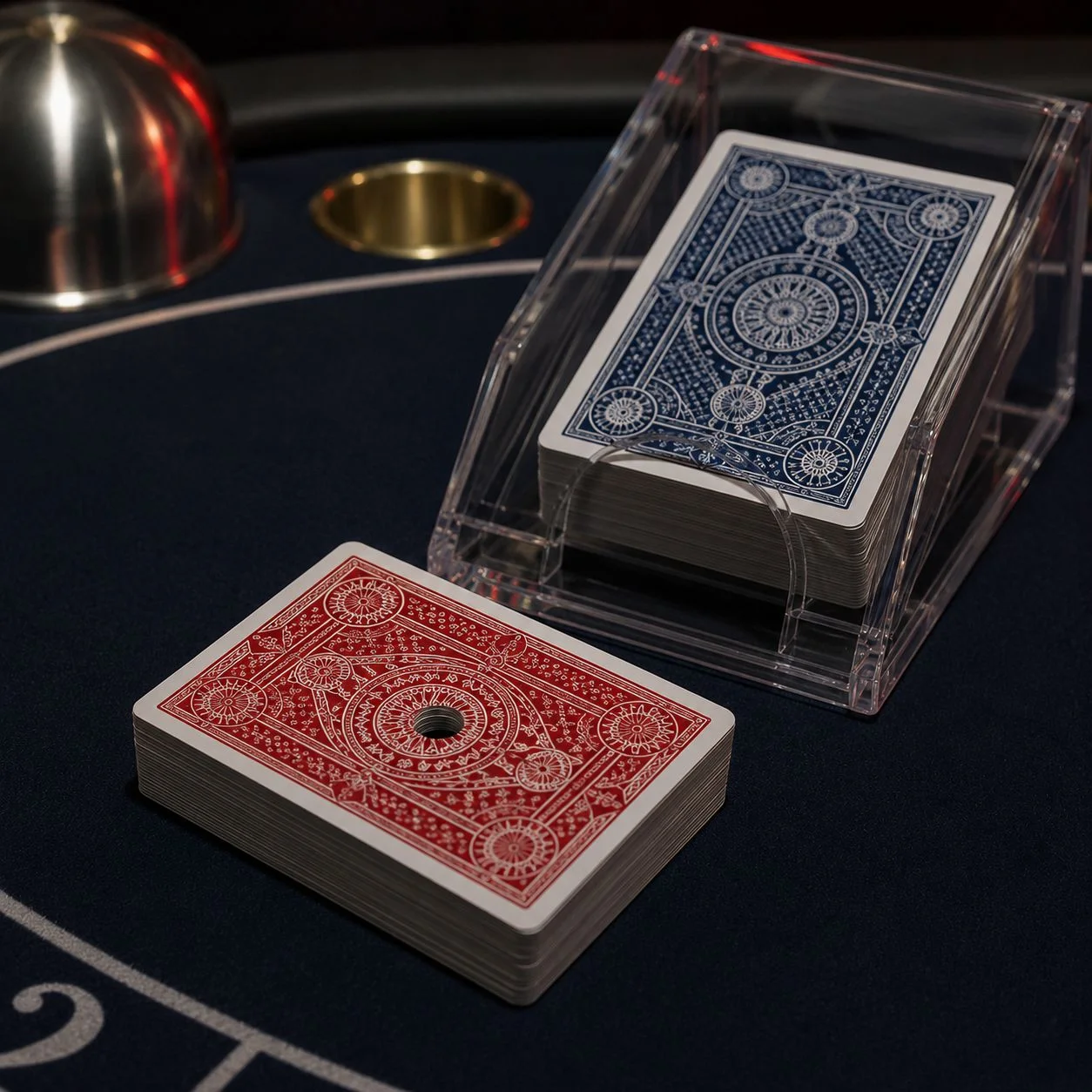
The deck on a live studio table has a completely different job. Its only purpose is to guarantee that the game is honest. So it isn't allowed to get soft, or stained, or memorable. It has to stay fresh, sharp and anonymous — and then it has to go. Around that simple idea the industry built an entire system: barcodes, a strict lifespan, and a procedure with a genuinely blunt name attached to it.
There's a Barcode on Your Cards
Bet you didn't know the deck now does a chunk of the job that used to belong to the dealer.
The cards are marked so a camera can read them automatically. Every suit, every value, logged the instant it lands — with no one having to call it out, count it, or double-check it. Which leaves the dealer free to do the one thing a machine genuinely can't: be good company. Warm, quick, professional, chatting with the table. All of that became possible because of one small thing printed on the cards.
A barcode.
It runs along the very edge of each card, tucked into the border in a strip you'd never notice in a hundred sessions. As the card slides out of the shoe and touches the felt, a camera using optical character recognition reads that strip and knows exactly what it's looking at. Suit and value, logged before your eyes have even focused on it.
So watch what the dealer actually does. She draws the card, and she places it — deliberately, in the same spot every time, so the edge falls into the camera's line of sight. That's the real skill of the hands: not counting, not calculating, but presenting each card where the system can see it. She doesn't count your money. She doesn't rule on your hand. The software works out every payout and settles every bet, identically, every single time.
Sounds a bit cold, doesn't it? Look again. That plain little marking on the edge of a card delivers something no human hand can — total accuracy, every round, with human error taken out of the equation entirely. A machine can't misread a card. It can't have a favourite player. It can't be nine hours into a shift and slightly checked out. And because every card is logged the moment it appears, any hand can be pulled up and replayed later.
Four Hours, Give or Take
Now the lifespan, which is shorter than most people would guess. A deck lasts roughly four to eight hours, and often nowhere near that — dealers change decks over and over inside a single shift.
The reasons sound almost petty. A corner that's gone slightly soft. An edge catching the light a fraction wrong. A bend you couldn't prove existed if someone paid you to. Any of that is enough, because a worn card isn't just a tired card — it's a readable one. A card that can be recognised from the back is the first chapter of every edge-sorting scandal the industry has ever had to apologise for. So fresh decks are inspected before play, and a riffle test can flush out a marked card by the way it moves and catches the light.
That's the trade your family deck never had to make: character, or certainty. A studio can only pick one.
The Whole Thing Costs Two Dollars
Precision costs money. Not dramatic money — planned money. Opening a live table means buying a broadcast-grade table, cameras sharp enough to read a card edge, glare-free lighting, the tablet sunk into the felt. Cards sit on the same list. Not an accessory — working stock, costed in advance like everything else: two to three dollars a deck printed in bulk in 2026, three to ten for casino-grade off a shelf.
So nobody hesitates. Retiring a deck mid-shift isn't a loss, it's the material doing its job. Pulling one because a corner looks soft isn't waste, it's the procedure working.
And consumable doesn't mean disposable. In some studios and casinos, a deck that's finished its working life gets a second one — well away from the game floor.
Then Someone Drills a Hole in It
The ending has an official name, and it isn't a gentle one: cancellation. The deck comes off the table and is physically wrecked so it can never go back into a game.
Why not just bin it? Because a deck that's merely thrown away can be fished back out — and slipping a familiar card back onto the felt is one of the oldest tricks in the business. A hole through the middle makes that impossible. Regulators around the world don't leave it to goodwill either: retired decks have to be defaced, and in a live studio it happens in a room that's filmed and supervised the whole time.
Cancellation means a hole drilled clean through the middle of all fifty-two at once — sometimes straight through the sealed pack, box and all. Others clip a corner off the whole deck, slot the edges, or stamp the backs with permanent ink. Some drill several holes in a set pattern, which works as a signature: it ties the deck to that casino, sometimes to that exact table. Collectors have learned to read those patterns and can tell you where a deck came from.
And the cost of the execution? A drill and a few seconds. No budget line, no invoice, no ceremony. The cheapest thing anyone does all day is the thing everything else rests on.
And Then It Ends Up on Someone's Coffee Table
An executed deck doesn't always stop there. Some studios do send them straight to be shredded and recycled — but around cancelled cards there's a whole culture of reuse. They make a great souvenir, and they're still a perfectly good deck for games that aren't played for money.
Land-based casinos have a fine tradition of sending retired decks to charity, donating them to schools and fundraisers. In parts of Nevada they've even gone out to a local prison, where inmates inspect and cancel them. The ones that get sold — usually for a dollar or two in the gift shop — quietly claw back part of the purchase cost and put the casino's logo in someone's living room. Collectors prefer the corner-cut style for exactly that reason: the branding survives, the deck still reads "void."
Cheaper, warmer, and a good deal kinder to the environment than a bin.
A Full Cycle, Run for One Accurate Game
So that's the whole life, start to finish, inside a few hours. Sealed pack opened on camera. Dealt for the number of rounds the rules allow. Executed. Turned into a souvenir.
All of it so you can sit down and think about one thing only — how much you're enjoying the game — and not spend a single second wondering whether something went wrong. Your family deck gets to grow old and creased because nothing is riding on it. This one doesn't, because everything is. Nobody advertises any of this. It's just the quiet answer to the question every player has muttered at least once: is this thing rigged?
Clever idea, honestly. And beautifully done.
Best Casinos