A record eight Arab nations reached World Cup 2026. Here is how the tournament reshaped the region’s football, and why it is the most exciting one yet to bet on

Some tournaments are remembered for a single goal. World Cup 2026 will be remembered for a whole region arriving at once. Eight Arab nations walked onto the biggest stage in football — more than ever before — and turned a summer of matches into a point of pride from Casablanca to Baghdad. It is the most compelling World Cup the Arab world has ever had to follow, and the most rewarding one to have a stake in.
Something shifts during a World Cup. People who never place a bet from one tournament to the next suddenly want a stake in it. It becomes part of how the match is watched — a pick in the family group chat, a small wager between friends, a reason to care about a game between two countries you'd never normally follow. In one pre-tournament survey, 43% of people said they planned to bet during the competition, and the vast majority of them only ever do it for the World Cup. For one month, a private hobby turns into a shared, almost social ritual.
The scale this year is unlike anything before it. World Cup 2026 is on track to be the largest betting event in history — more than $50 billion in projected global wagers, up from $35 billion in 2022 — with more people able to bet legally than at any previous tournament. That means every kind of fan is catered for, from the once-a-tournament punter to the daily follower. The good news is there's a sportsbook for every taste — these casinos offer a full range of sportsbooks, and all that's left is to pick the one that fits you.
A record eight teams — and two of them had never made it before
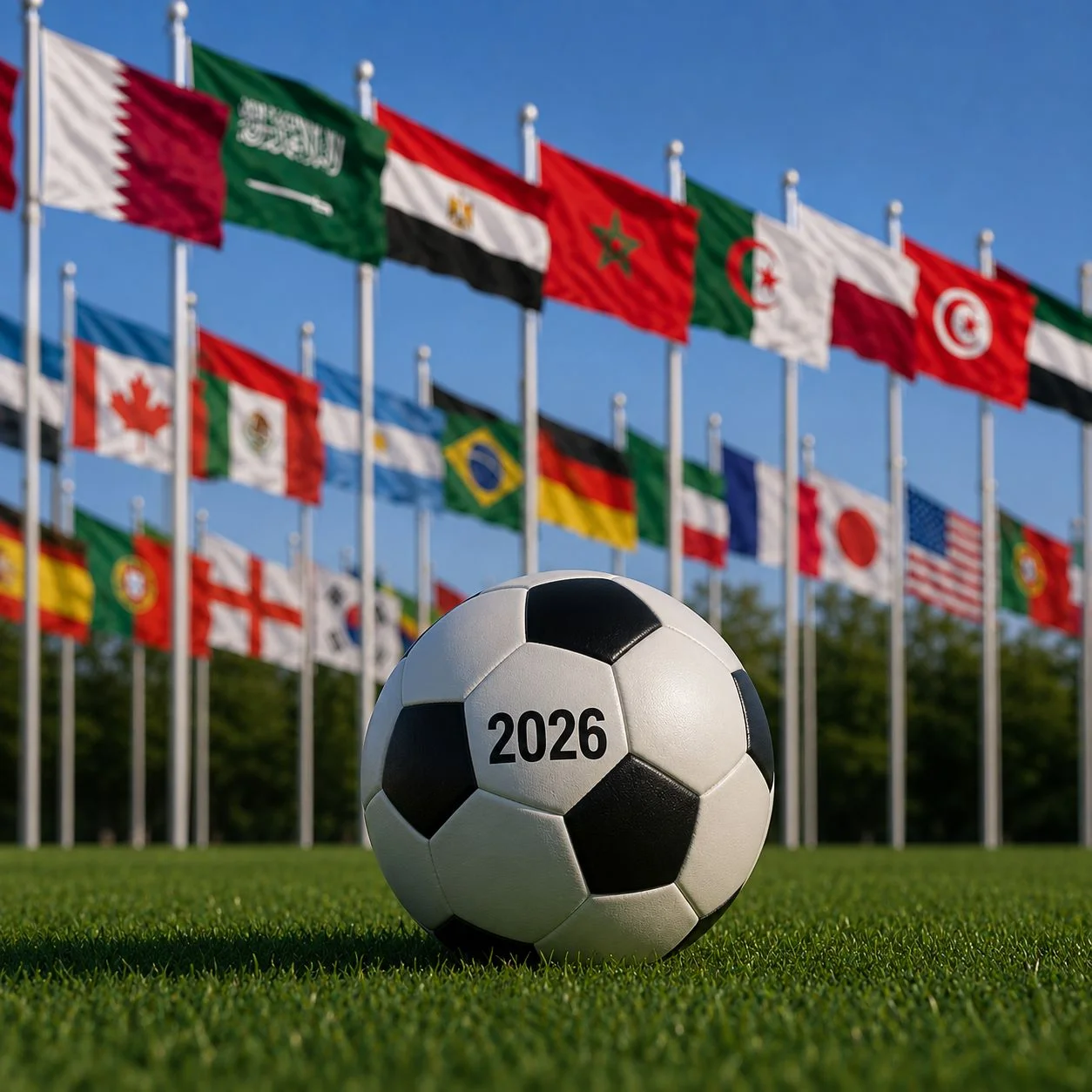
Algeria, Egypt, Iraq, Jordan, Morocco, Qatar, Saudi Arabia and Tunisia all qualified for World Cup 2026. That is eight Arab nations at a single tournament, double the four that featured in both 2018 and 2022, and the largest Arab presence in World Cup history.
Two of those stories are pure history. Jordan reached a World Cup for the first time ever — a nation watching its flag at the finals for the first time in its life. Iraq came back after nearly forty years away, since 1986, after the longest qualifying campaign of any team in the field. On 22 June, Algeria met Jordan in an all-Arab fixture on football’s grandest stage — a sentence that would have sounded far-fetched a decade ago.
And the teams have not come to make up the numbers. In the opening days, Egypt held Belgium to a draw and Saudi Arabia did the same to Uruguay — two Arab sides trading blows with a European and a South American heavyweight, and walking off with a point each. This is a region competing, not attending.
Built on Morocco’s breakthrough
None of this came from nowhere. In 2022, Morocco became the first Arab and first African team ever to reach a World Cup semi-final. In the same tournament, Saudi Arabia beat the eventual champions, Argentina, in the group stage. Those results were not flukes that flattered underdogs. They were proof of concept.
The belief that carried eight teams to 2026 was lit in Qatar. You can trace the line directly: a region that once hoped simply to qualify now turns up expecting to compete, and a generation of players grew up watching Arab teams win matches that used to feel out of reach.
The magic that makes this tournament impossible to ignore
The World Cup also does something no other event can. It can turn an unknown into a global name in ninety minutes. On 15 June in Atlanta, Cape Verde played their first-ever World Cup match against Spain, one of the favourites to win the whole thing. Their goalkeeper, a 40-year-old journeyman known as Vozinha, faced a barrage of 27 shots and made seven saves — stopping everything that mattered. Cape Verde walked off with a 0-0 draw and the first World Cup point in the nation’s history.
He started that day with around 50,000 Instagram followers. Within 24 hours he had more than eight million. One night on the world’s biggest stage rewrote a career that had quietly passed through Portugal, Angola, Moldova, Cyprus and Slovakia. That is the pull of this tournament — and with 48 teams in the field, there is more room than ever for a small nation to write that kind of story. Several of the Arab sides are built to do exactly that.
One tournament, sixteen cities — and bets that travel
This World Cup is played across sixteen host cities in three countries, from Vancouver to Mexico City to Miami. The tournament is genuinely everywhere at once, spread over a whole continent and a fistful of time zones. The remarkable part is that you do not have to move at all. You follow it from a single screen, and your stake rides along to every stadium on the map — a bet placed in Riyadh or Dubai is live on a match in Kansas City the moment the ball moves.
That borderless feel is part of why crypto has become such a natural way to follow the action. The same way the tournament crosses borders, paying with crypto lets your funds cross them too — quick, and without the friction of currency conversions or slow bank transfers. For a competition that spans the globe, it is a fitting way to be part of it.
A region investing in the game
The rise is not only on the pitch. Saudi Arabia’s league has drawn some of the biggest names in world football, and the country will host the World Cup itself in 2034. Across the Gulf, the game has become a national project rather than a pastime — academies, infrastructure, and money flowing into talent at home.
World Cup 2026 is where that investment started to show its return: younger squads, deeper benches, and footballers who came up believing the World Cup was theirs to reach too. The eight flags spread across the United States, Canada and Mexico are the visible tip of a much larger shift.
The biggest betting tournament ever — and Arab teams are in the conversation
For anyone who likes a stake in the action, 2026 is the richest World Cup there has ever been. It is the largest betting event in history, with more than $50 billion projected in global wagers, up from $35 billion in 2022. The first 48-team field brings 104 matches, twelve groups and an expanded knockout round — more markets, more drama, and more reasons to follow every group right to the final whistle.
And for the first time, Arab teams are not priced as tourists. Backing Morocco to go deep into the knockouts, or Saudi Arabia to spring another upset, is a genuine football position now, not a sentimental one. That is the real pleasure of it: when you have a stake in your nation’s match, every pass carries weight. Follow it for the football, back it for the thrill, and keep it within what you enjoy losing — the fun is in being part of the story, not chasing it.
The tournament the region had been waiting for
World Cup 2026 is the summer Arab football stopped knocking on the door and walked in. Eight flags, two debutants’ first-ever finals, a goalkeeper who became famous overnight, and a region that finally expects to belong on the biggest stage there is. Whether you are here for the football, the pride, or the thrill of backing your team, this is the one to be part of.
On Arab-Casinos.com we vet the platforms that take Arabic-language bets with fair odds and proper licensing — so following your team is as easy as it should be.
Best Casinos